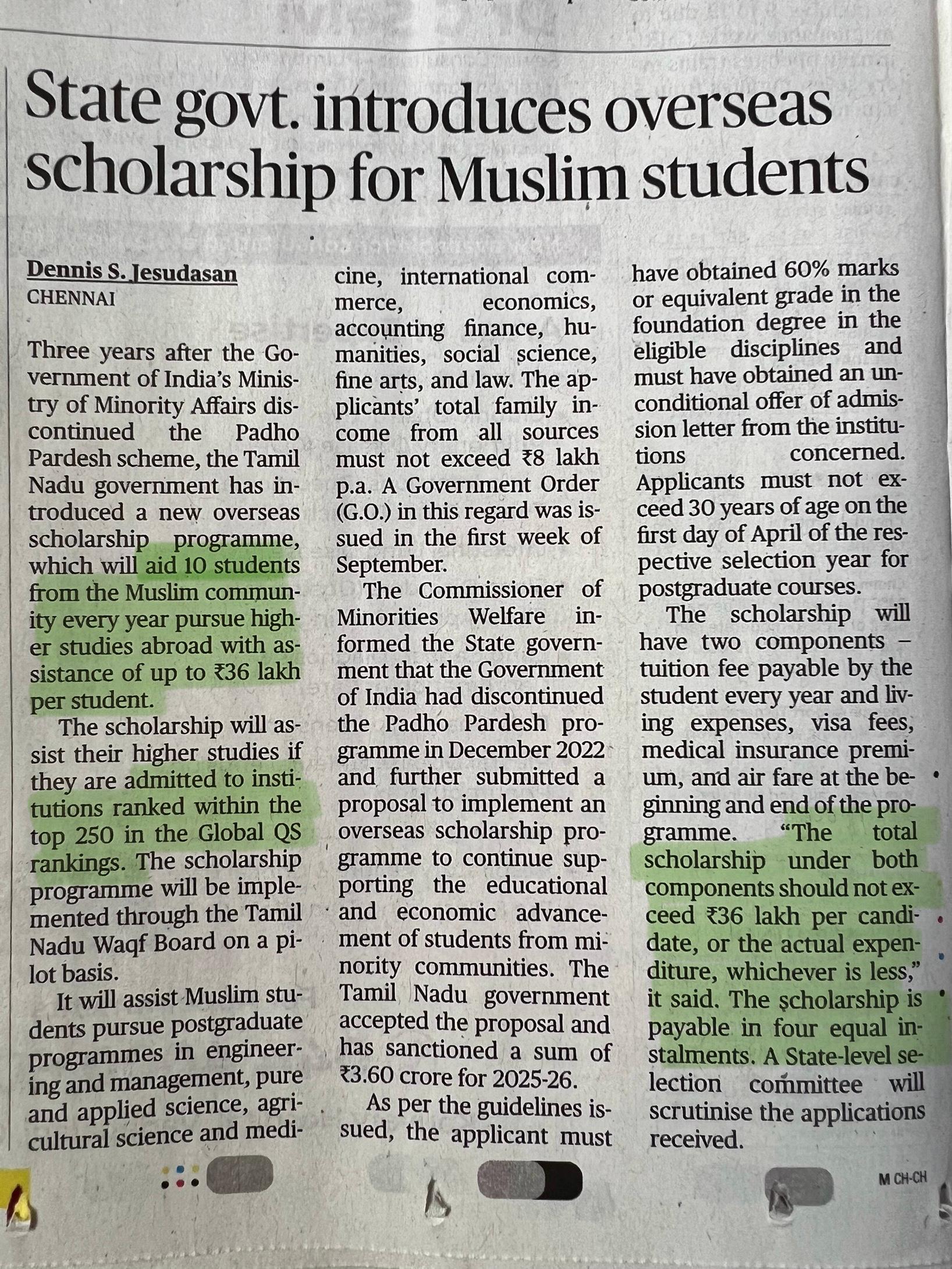
In a landmark initiative, the Tamil Nadu government has introduced a new overseas scholarship programme aimed at empowering Muslim students to pursue higher studies abroad. This comes three years after the Government of India’s Ministry of Minority Affairs discontinued the Padho Pardesh scheme.
Under this new scheme, 10 students from the Muslim community will be selected each year to receive financial assistance of up to ₹36 lakh per student to cover tuition fees and living expenses. The programme will be implemented through the Tamil Nadu Waqf Board on a pilot basis.
Key Highlights of the Scheme:
- Eligibility: Students must gain admission to postgraduate programmes in reputed institutions ranked within the top 250 of the Global QS rankings.
- Fields of Study: The scholarship supports postgraduate studies in disciplines such as engineering, management, applied science, agriculture, medicine, international commerce, economics, accounting, finance, humanities, social science, fine arts, and law.
- Income Criteria: The applicant’s family income from all sources must not exceed ₹8 lakh per annum.
- Academic Requirements: Students should have secured at least 60% marks or equivalent in their foundation degree and must present an unconditional offer letter from the admitting institution.
- Age Limit: Applicants must not be older than 30 years of age as of April 1 of the selection year.
Financial Assistance:
The scholarship has two components – tuition fee and living expenses. The total support will not exceed ₹36 lakh per candidate or the actual expenditure, whichever is lower. This financial aid will be disbursed in four equal instalments throughout the programme.
Government’s Commitment:
The Tamil Nadu government has sanctioned ₹3.60 crore for the academic year 2025-26 to implement this initiative. The Commissioner of Minorities Welfare confirmed that a State-level selection committee will be responsible for scrutinizing applications to ensure transparency and fairness.
Why This Matters:
This initiative is not just about funding education but about creating opportunities for students from minority communities to access world-class institutions and contribute meaningfully to the fields of science, technology, commerce, and the arts. By investing in the academic future of Muslim students, the government is taking a significant step toward inclusivity and educational advancement.
Final Word: The new overseas scholarship scheme is a beacon of hope for aspiring Muslim students in Tamil Nadu, opening doors to global education and empowering them to excel in diverse fields. This initiative could serve as a model for other states to follow, ensuring that education remains a tool for equality and progress.